


Sharder?—?China’s Sleeping Giant of Data Storage

In China, the world’s most populous country and soon to be leader in information technology, a little known company with a grand vision is laying the foundation to become the leader in data blockchain technology. Named after the technique of slicing data and storing it across servers, Sharder is a sleeping giant rising up in China, ready to battle the country’s massive data needs.
A Data Explosion
The world is awash in data. Every new technological advancement, such as the development of blockchain technology which we are currently witnessing, brings an avalanche of new data. According to IDC Research, digital data is growing at an amazing compound annual growth rate of 42%. Hal Varian, Chief Economist at Google summarized it well:
“Between the dawn of civilization and 2003, we only created five exabytes; now we’re creating that amount every two days. By 2020, that figure is predicted to sit at 53 zettabytes (53 trillion gigabytes) — an increase of 50 times.”
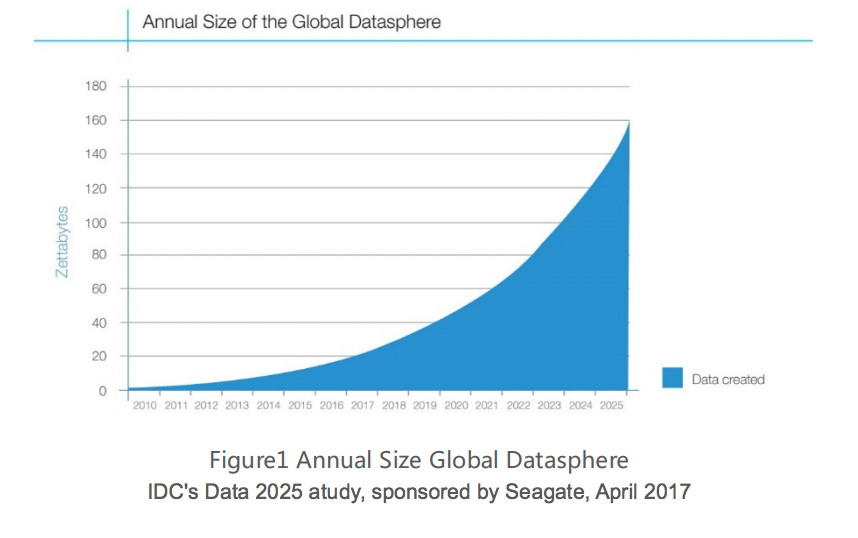
Corporate enterprise has been at the center of this data tsunami and they have struggled to keep afloat. We’ve seen the evolution of data management solutions go from powerful individual servers, to rows of racked blades in corporate data centers, and finally migration to cloud providers. None of the solutions has been effective as the cost of data storage has risen, privacy and security have been challenged, and centralization has undermined resiliency. The problem was crystalized in 2017 when an Amazon S3 outage brought down a large number of applications across the Internet.
Data Storage On The Blockchain
Despite the Amazon fiasco, 2017 may be remembered as the year when the decentralized blockchain was introduced as the most promising solution to the data storage and management issues faced by companies. The year saw a number of companies including Sia, Storj, Maidsafe, and Filecoin introduce blockchain-based data storage offerings to market. Investors recognized the potential by rewarding these companies with massive market capitalizations through public and private ICOs. At the peak of the market in 2017 the following were the market caps:
Siacoin — $3 billion
MaidSafe — $500 million
Storj — $400 million
In one month alone, Filecoin raised almost $300 million from investors. Even after the recent market correction, the market capitalizations are still significant. Although the numbers are staggering for new, mostly unproven companies, they reflect the opportunity that exists in this market. By the end of 2017, Sia for example reported that they had 400 terabytes in paid contracts for customers utilizing their solution. This represents real customers deciding that blockchain offers a lower cost, greater security, and higher resiliency solution as compared to centralized, and more costly offerings from Amazon, Google, and other providers.
While the upstart data storage blockchain companies battle over the U.S. market, it is the China market that is open for the taking. China is quickly becoming a global leader in technology and with a rising standard of wealth and more than a billion potential consumers, China’s data storage needs may overtake that of the U.S. in the very near future. This is where Sharder has positioned itself as a front runner.
Sharder’s Data Blockchain Solution
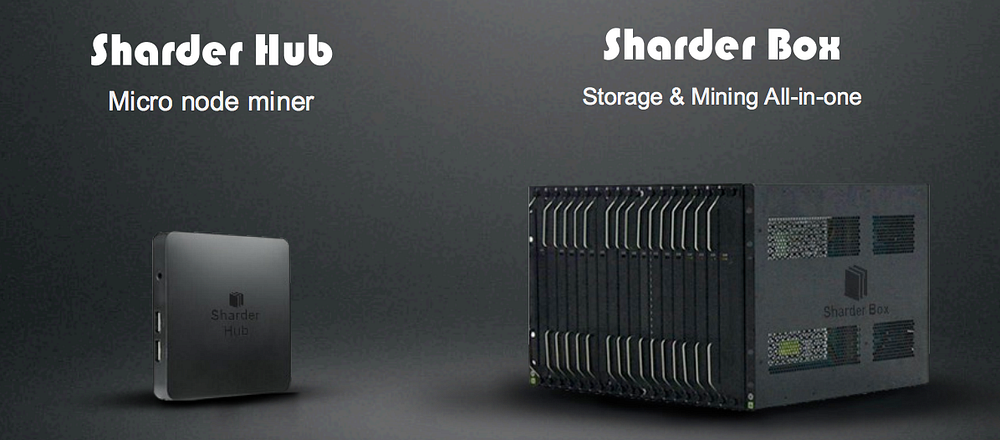
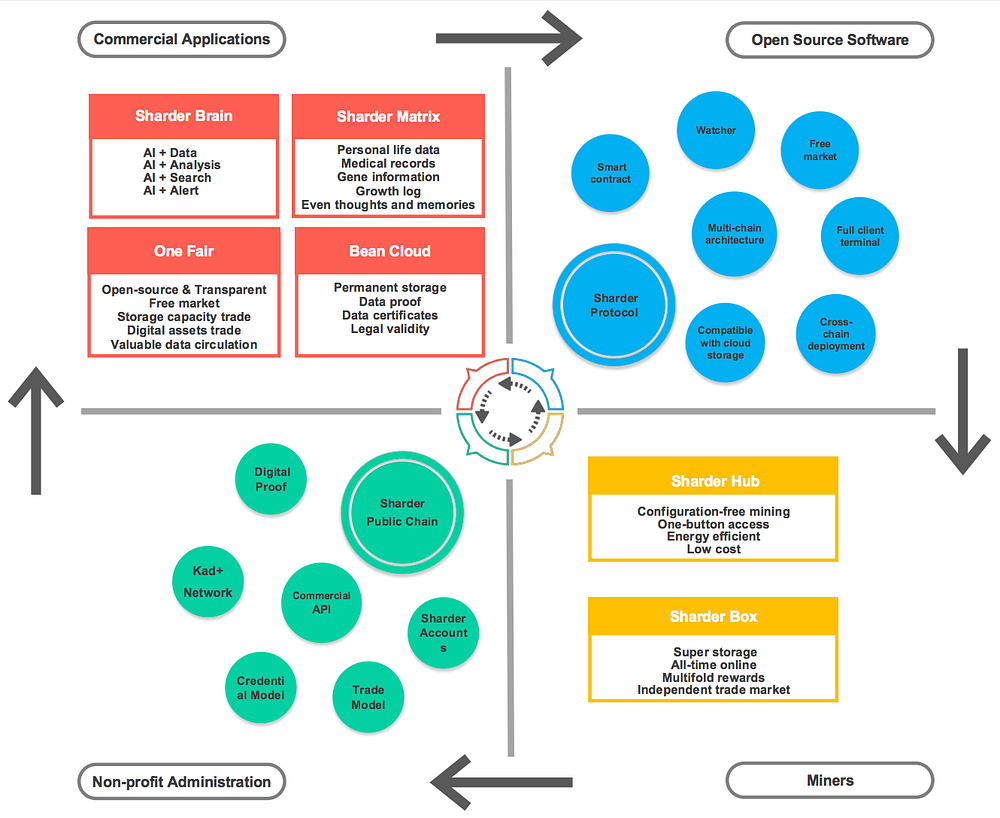
Sharder labels itself as a “cross-chain distributed storage protocol” that will provide a fast, secure, and reliable global storage network. Sharder has developed a custom blockchain and open-source protocol that shares many of the basic concepts of other distributed data storage approaches while improving on others. At the most basic level, Sharder creates an open marketplace for storage providers and storage buyers. Airbnb and Uber have taken the sharing economy by storm. The next phase will be sharing of computer resources. In the Sharder model, tokens are used for buying storage space and for rewarding those who provide storage to the network. The network won’t be reliant just on home users and their often slow internet connections, but will include miners who use a proof of consensus algorithm to add data transactions to blocks and to store data. Sharder even provides mining equipment including a micro node miner (Sharder Hub) and storage-mining all-in-one box. (Sharder Box)
Sharder borrows from Bitcoin the concept of UTXO (unspent transaction output) to manage the accounting, and from Ethereum turing-complete smart contracts to set to the rules and requirements for storage. The technology includes the Kademlia protocol, a distributed hash table that is popular in P2P systems and used to aid with message routing, erasure coding which allows recovery of distributed data in case of data failure, and a “watcher” process designed to reduce data redundancy through efficient data distribution and to keep the network synchronized.
An Open, Multi-Purpose Blockchain
Although data storage is at the center of Sharder’s plan, their vision is much grander than simply managing files and data. Sharder envisions a multi-purpose blockchain and data ecosystem that leverages stored data for many different use cases. These include applying AI to make the the blockchain intelligent, secure and more efficient. Called the Sharder Brain, AI will not only improve the functioning of the network and make smart contracts easier to use, it will extract value from existing data in a variety of different ways. Sharder is also targeting a personal data store where users can manage health and biological data such as genetics and health records. They envision an open marketplace called One Fair where clients can buy and sell data and it leverages work they have done already with Conch chain, a blockchain market for creative licensing.
To make these ideas a reality, Sharder is opening up their blockchain in a number of different ways. First they are building the Sharder chain as an open protocol with source code available on Github. Organizations will be able to run the protocol as part of a private chain. Second, they are building a platform for third parties to build DApps. This will allow developers to leverage the Sharder protocol and the large amounts of data available on their blockchain. Finally and perhaps most exciting is Sharder’s mission to create a cross-chain blockchain. Although the technical white paper has yet to be translated into English and the Google Translate version is hard to read, one can surmise that since most blockchains aren’t optimized for data storage, third-party blockchains will be able to leverage Sharder’s data storage capacity in a cross-chain format. QTUM is listed on Sharder’s website so perhaps a partnership is in the works.
Conclusion
There is no doubt that Sharder has ambitious plans to capture the Chinese data storage and management market. They certainly have a tremendous opportunity and their highly technical team has laid out credible details of how they plan to get there. If they can develop additional partnerships with private industry and government and enhance their marketing capabilities, and with their hard cap of less than $10 million, the secret of this sleeping giant won’t last for long.
Website: sharder.org
Telegram: https://t.me/sharder_cn
Whitepaper: https://oss.sharder.org/sharder/whitepaper/sharder-whitepaper-v1.0-en.pdf
ICO Date: February 23
Follow me on Twitter @steadydee